About
I was trying to be useful
When I first began facilitating, I cared deeply about helping people become more free.
I was drawn to theatre, movement, improvisation, puppetry, expressive arts, clown, ritual, and participatory performance. I loved watching someone discover that they weren't fixed, that something they had assumed was simply “how I am” could suddenly become a little more movable.
But my attention kept moving beyond the workshop itself. I became interested in what happened afterwards: the conversation with a partner, the meeting at work, the family dinner, the moment someone hesitated, the moment someone reassured, or the moment a room decided who would carry the uncertainty.
Those ordinary moments seemed to shape our lives at least as much as the extraordinary ones.
Then I found puppets
For my diploma in Puppet Therapy, I designed an intervention for parents of autistic children around a question that has never really left me: How do we remain in relationship with another being whose way of meeting the world may never resemble our own?
Puppetry gave me a way to explore care, difference, dependence, and the strange things we do with what we don't fully understand. It offered a way to practice proximity without control, rescue, or withdrawal.
That became the beginning of Deep Puppetry.
Around the same time, I encountered Vygotsky and Social Therapeutics. I became fascinated by the idea that development isn't something that happens inside an individual and then gets expressed between people. It lived between people.
Years later, while facilitating with people living under conditions of war, the practice reached a limit. The assumptions I had been working from no longer fit the reality in front of me. I could have protected the method. Instead, I changed it.
After that, I became increasingly interested in something more ordinary and more difficult to see: how quickly we decide what something is, and how our participation helps make that decision real.
An object becomes a character
A gesture becomes a meaning
A person becomes understandable
And if we stayed just a little longer, the encounter often had more to give. Our first understanding wasn't necessarily wrong; it just wasn't finished.
I became less interested in how people change and more interested in what kinds of participation make different ways of being together possible.
The question kept changing shape
That question has continued to take different forms.
I've developed practices, courses, participatory artworks, performances, and training environments around it, including School of the Small and Imperfect and Witnessing Without Colonizing. Some have stayed, and some have changed. Some may return in another form.
There was another shift that took longer. The more helpful I tried to be, the more easily the room began organizing itself around me.
People looked to me for what mattered, for what things meant, and for what should happen next. At first I mistook that for trust. Sometimes it was, but mostly it meant people were becoming more responsive to me than to what was happening between them.
That unsettled me. I didn't stop caring about helping. I became increasingly curious about what my helping sometimes prevented. I didn't want my understanding, my insight, or even my care to become the thing around which everyone else gathered. I wanted to see whether it was possible to compose conditions strong enough that the work no longer depended on me.
Where people, materials, questions, and encounters could begin teaching all of us, including the facilitator. I’m still practicing that.
Today
Deep Puppetry is the main expression of this work now: an artistic practice for staying with encounter while it is still becoming.
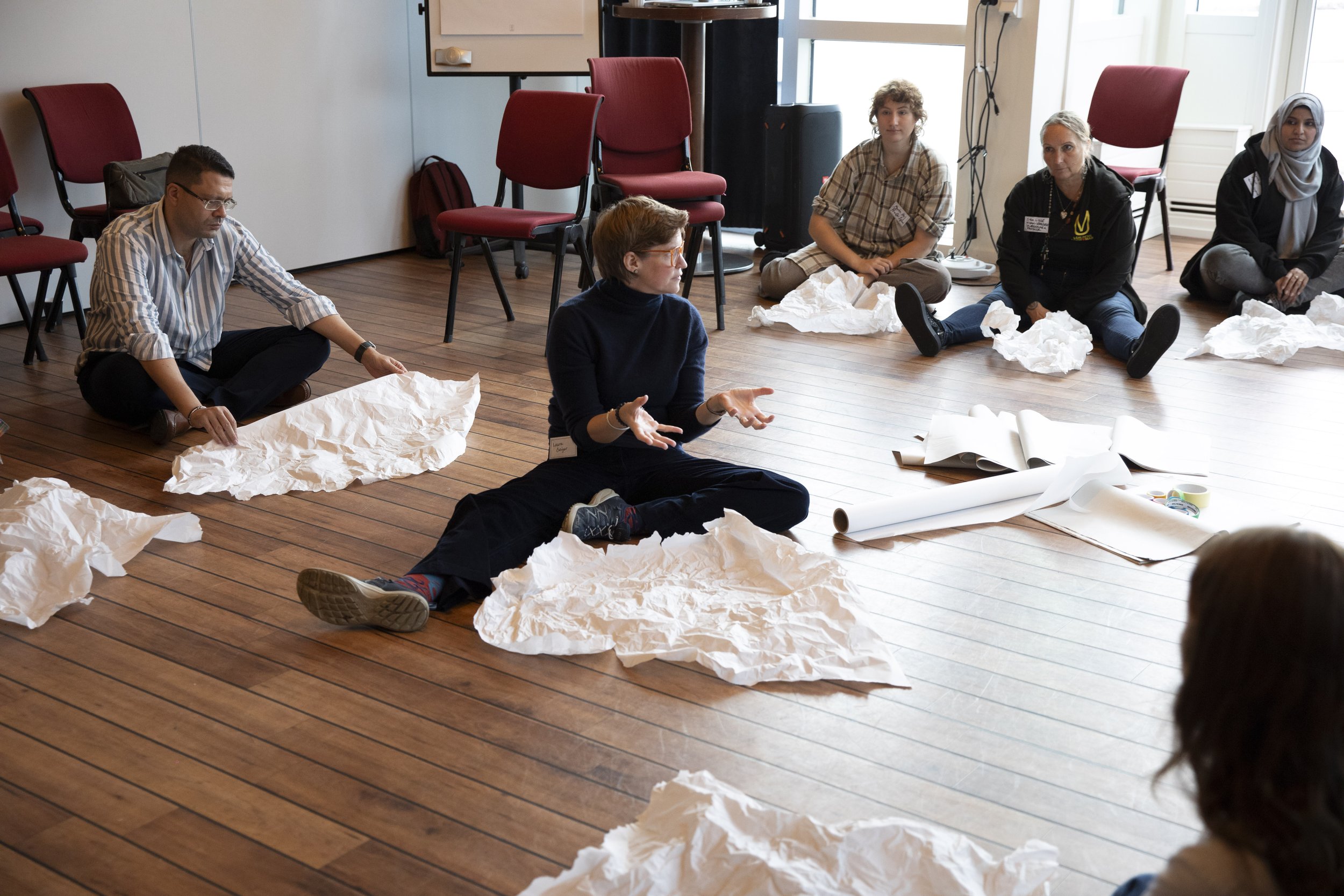
I'm an artist, teacher, and facilitator. I've been working across artistic, educational, community, and relational contexts for more than twenty years, in Sweden, Canada, the US, and internationally.
More than 500 people have participated in Deep Puppetry work with me in the last four years alone.
Across my wider practice, I've worked with thousands of people through teaching, facilitation, and coaching, and I have more than 1,000 hours of group facilitation experience.
My work has moved through community care and activism, expressive arts, voice and somatics, applied theatre, puppetry, performance, visual art, education, spirituality, and relational practice.
The forms have changed considerably over the years. The thread has been an interest in what becomes possible when we participate differently.
Selected collaborations
Rutgers University
University of North Carolina
Anna Lindh Foundation
Misk Global Forum
Malmö Folkuniversitet
Helsingborg Municipality
East Side Institute
Festival of Ecology, Stage and Transformation
Skillinge Teater
Toronto District School Board
Heart and Stroke Foundation of Ontario
I've developed original practices and courses including Conscious Voicework®, Deep Puppetry™, School of the Small and Imperfect, and Witnessing Without Colonizing, alongside more than 200 workshops and trainings.
My formal education includes a BA in Sociology, a post-graduate diploma in Health Education, and a diploma in Puppet Therapy.
I've also studied Social Therapy with the East Side Institute and trained extensively across movement and somatics, applied theatre, Theatre of the Oppressed, puppetry, voice, expressive arts, relational practice, neurodevelopment, and other embodied and participatory approaches. I think of this less as a list of credentials than as a lineage of questions, practices, and people who have changed how I work.
I don't know where the inquiry leads, but I hope I keep listening.
“A trustworthy kind of disorientation. Our hours together altered how I moved, noticed, and responded to my life. Here, there is the possibility of relational habits becoming visible, becoming relational skills to move with rather than be bound by.”
-Karalyn Riepert