Most teams don’t have a communication problem.
They resolve interaction too quickly.
relational field lab
A short organizational lab where teams can see what fast coordination normally hides
Especially useful for teams working with facilitation, equity, learning design, or organizational change where participation dynamics shape outcomes
What organizations often notice before reaching out
Teams usually approach this work when something subtle but persistent is happening in their dynamics:
• the same people repeatedly carry coordination
• important concerns appear too late to influence decisions
• hesitation is mistaken for disengagement
• urgency concentrates authority
• some voices disappear while others become structurally necessary
• equity conversations stall even when everyone agrees on the values
None of this is usually intentional.
Meetings move forward, decisions get made, people align.
And still something feels off.
These patterns rarely originate in individual personalities or values. They emerge through coordination pressure.
When something is unclear or unfinished, teams move to resolve it quickly so work can continue.
This resolution often happens through explanation, reassurance, or decision-making.
It keeps the group moving, but it also determines who carries responsibility, whose input shapes outcomes, and what disappears before it can fully emerge.
What this lab is
Most teams coordinate so quickly that they never see how participation is actually organizing responsibility, authority, and silence.
Relational Field Lab slows coordination just enough for teams to see how these patterns are forming in real time.
The lab functions as live organizational inquiry rather than a problem-solving workshop.
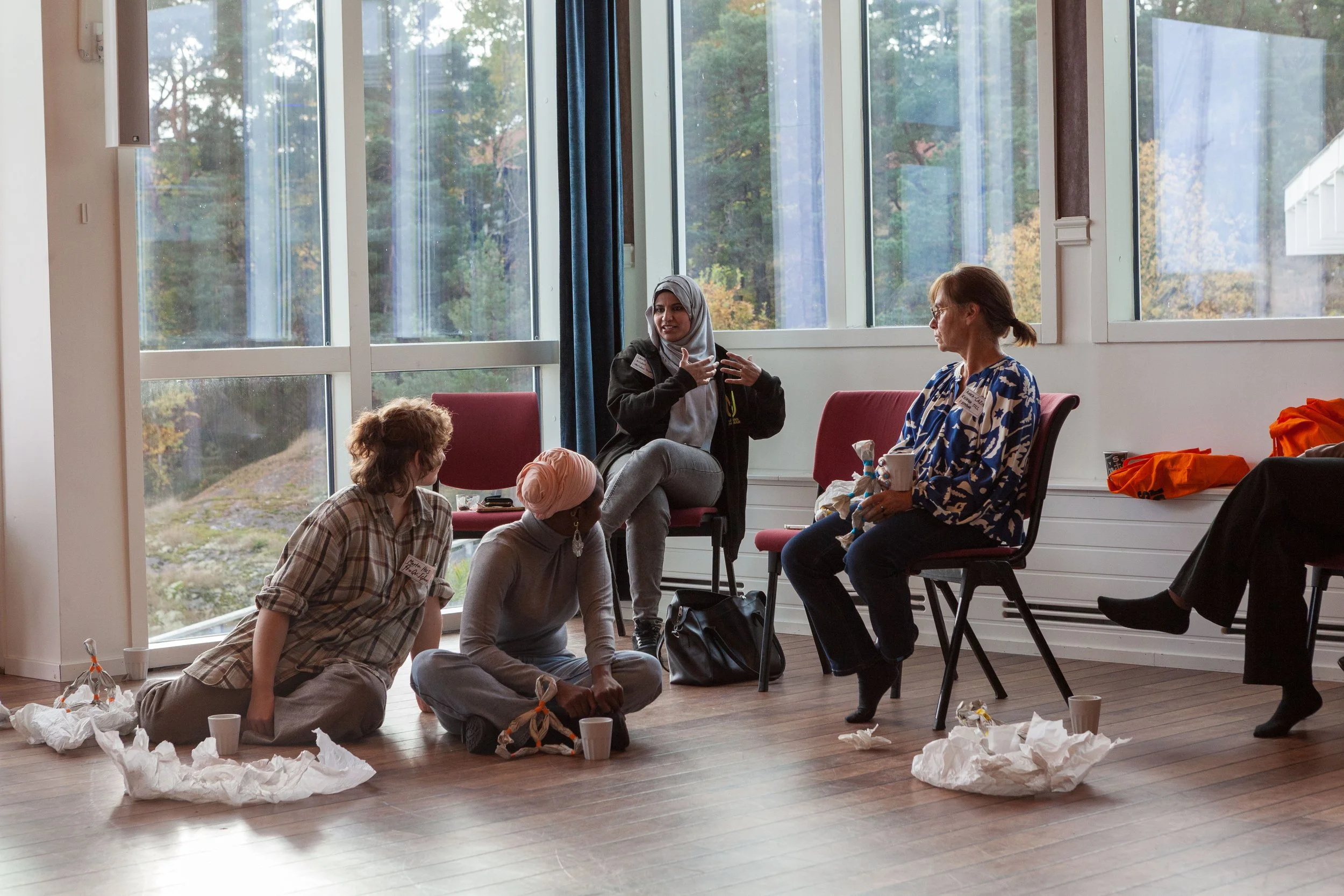
Participants enter simple coordination situations where the group must move forward without the usual supports:
• assigned roles
• reassurance
• hierarchy or positional authority
• pre-agreed consensus
No one is “in charge” in the familiar way.
Because the structures are simple and instructions are minimal, the dynamics of participation become easier to see.
What matters is not what people say they believe but what they do once they are inside the interaction.
Seeing these patterns while they form changes how teams respond to them.
What participants actually do
Participants enter a small number of live coordination situations designed to make normally invisible participation patterns visible.
The situations are deliberately simple.
Participants are asked to do things organizations rarely practice directly:
• coordinate without clarity
• wait without reassurance
• act without permission
• hold responsibility without authority
• refrain from fixing what is visibly strained
Because instructions are sparse and discussion is limited, attention stays on what participation actually does in the moment rather than on explaining it afterward.
In the lab, awkwardness, misalignment, and unevenness are not treated as problems to solve.
They become the material of the lab.
What teams often notice during the lab
Teams usually recognize patterns very quickly.
Within the first exercise, participants often begin noticing who steps in to keep the group moving, how hesitation becomes costly when no one responds to it, and how authority can appear without anyone assigning it.
For many teams, this is the first time participation dynamics become visible as a shared phenomenon rather than as individual behavior.
The value comes from seeing it while it is happening, together.
Why organizations use this lab
Turnover, strategic drift, stalled equity initiatives, and ethical fatigue are often treated as failures of leadership, communication, or culture.
But many of them originate earlier: in how quickly interaction is resolved as teams try to move forward.
When coordination accelerates, responsibility tends to concentrate, dissent disappears early, and urgency reshapes care into control.
Relational Field Lab allows organizations to encounter these dynamics as procedural rather than personal, which makes responsibility possible without blame and change possible without heroics.
The lab makes this visible while it is happening, not as reflection but as shared experience.
What this lab is not
This is not therapy, coaching, or facilitation aimed at alignment, buy-in, or “culture change.”
No one is asked to disclose personal material, and no one is evaluated.
This is not individual performance development.
There is no correct way to participate.
It is simply a chance to observe how coordination organizes participation inside your team.
Most teams have never had a way to see this directly.
What the lab does not promise
This is not a solution, and there is no action plan.
Nothing is fixed by the end.
What the lab offers instead is something less comfortable and more durable:
• the ability to recognize coordination patterns while they are happening
• a shared reference point for discussing participation without accusation
• greater tolerance for unfinished ethical questions
• less dependence on urgency, charisma, or over-functioning to keep things moving
Any changes that follow belong to the organization.
The lab does not take ownership of outcomes.
Who initiates this work
This work is usually initiated by people already responsible for learning conditions, ethics, or group process:
• program leads
• learning designers
• facilitation teams
• equity or organizational development groups
The lab is most useful when an organization senses something structural in its dynamics but cannot yet name it.
It can be proposed as a contained pilot.
Some organizations choose to continue the work through an extended lab format where teams experiment directly with how coordination patterns can be interrupted, redistributed, and repaired under pressure.
Format
2.5 hours (adaptable)
8–14 participants
In person or on Zoom
Closed, organization-specific group
It can stand alone or sit alongside other internal work.
Facilitation
Relational Field Lab is facilitated by Laura Geiger. Her work focuses on how groups are shaped long before beliefs or intentions can intervene and what happens when those shaping forces become impossible to ignore.
Laura’s relational practice work has been hosted by Rutgers University, the University of North Carolina, the Anna Lindh Foundation, Misk Global Forum, and Malmö Folkuniversitet.
Facilitation is active but restrained.
Structure does the work. Coherence is not rescued.
Investment
Labs begin at 22,000 SEK ($2300) and scale based on scope and context.
Next steps
Relational Field Lab is designed as a contained pilot.
Many organizations begin with a single lab to see whether the work is useful before considering anything further.
The first step is simply a short conversation about:
• what dynamics you’re noticing
• what context the team is working inside
• whether a lab would make sense
If it does, we schedule the lab.
If it doesn’t, that’s useful to know too.
If you’re curious whether this lab would be useful for your team, you’re welcome to reach out.