advanced training in power-aware facilitation
Recognizing and Responding to Hidden Domination Patterns in Groups
A six-week professional training for experienced facilitators, educators, and group leaders
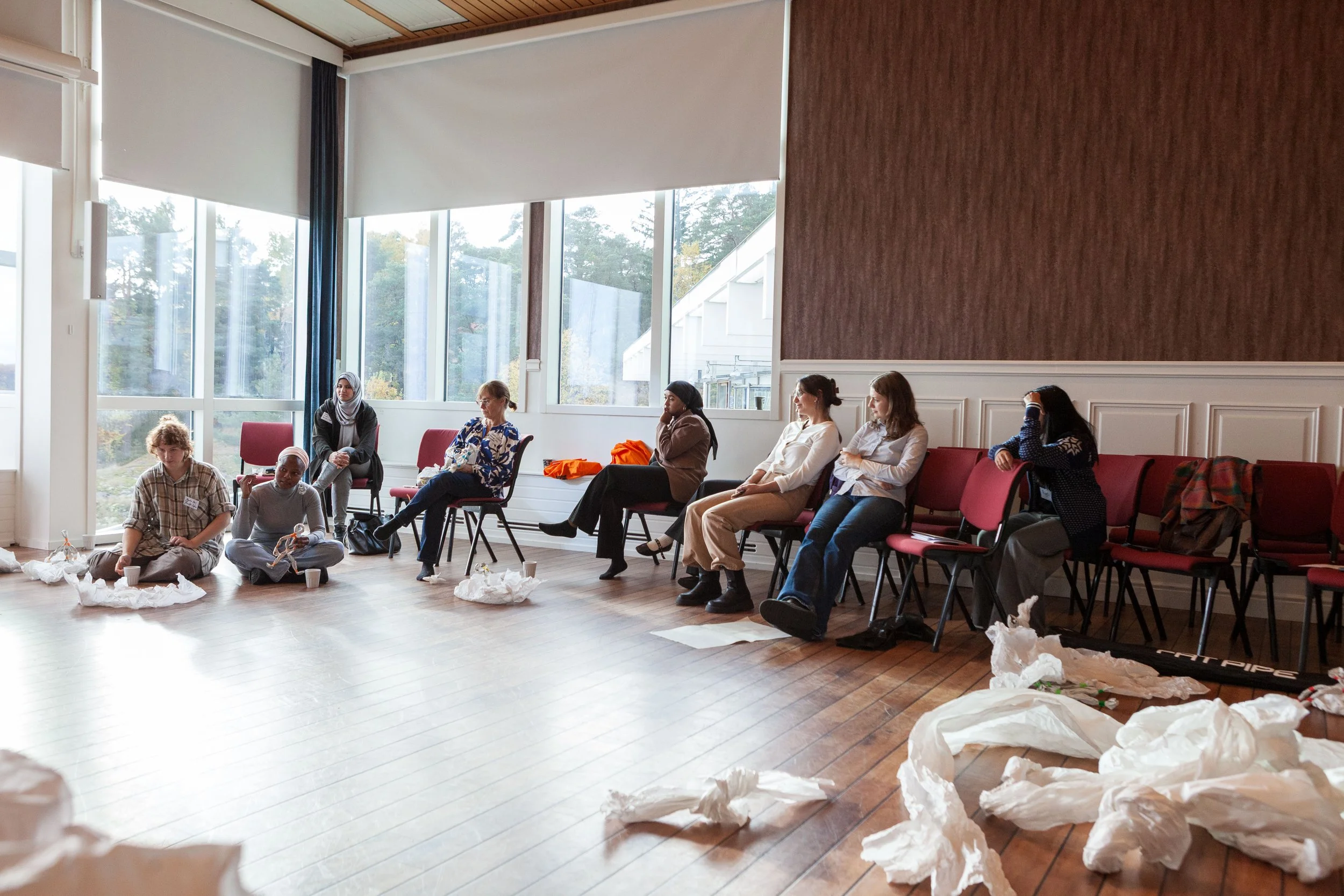
Most facilitator trainings teach how to hold space.
This training teaches how to interrupt it responsibly.
Many facilitators care deeply about ethics, equity, and participation and still encounter moments where something in the room narrows before they can fully see how.
Responsibility gathers quietly.
Authority appears without being named.
Tension disappears before its implications can be understood.
Often these moments pass too quickly to study.
This training exists to slow them down - not to fix them, but to make participation visible while it is organizing power.
This advanced training is for facilitators who recognize that good intentions alone do not prevent domination patterns and who want a place to study how participation actually shapes authority, responsibility, and possibility in real time.
Participants practice working inside complexity without relying on certainty, neutrality, or moral perfection.
This training does not teach scripts or formulas. The emphasis is on perceiving participation accurately rather than producing particular outcomes.
It builds perceptual range and ethical participation capacity through live group practice.
This training draws from Laura’s most extensive Relational Fieldwork practice environments.
Applications support cohort alignment and do not commit you to enrollment.
Cohort size is intentionally limited to support depth of practice.
You might recognize this moment
You’re facilitating a meeting. The room goes quiet. One person starts carrying the emotional weight while another withdraws.
You feel pressure to stabilize the moment.
You intervene. The tension diffuses. Something important disappears.
Or:
You sense hierarchy forming - in timing, in who explains, in who moves first.
You hesitate. If you intervene, you might disrupt trust. If you don’t, the pattern solidifies.
This training is designed to slow down moments like these, make them visible, and expand how facilitators can participate inside them.
Clarifying the kind of facilitation this training addresses
In most facilitation contexts, intervention means guiding a process like choosing an activity, clarifying instructions, or helping a group reach a decision.
In this training, intervention refers to something different. It means responding to participation dynamics between people while they are forming in the room.
Examples include noticing when:
• authority begins concentrating around certain voices
• responsibility shifts onto one participant
• reassurance suppresses disagreement
• explanation begins narrowing participation
• urgency reorganizes how decisions are made
Intervention here means shifting how participation is organizing the room, rather than introducing a new activity or directing the group toward an outcome.
This training focuses on facilitation contexts where participants are actively interacting with one another such as discussions, collaborative work, or process-based groups, rather than primarily engaging with a facilitator-led activity or practice.
What it’s actually like to be inside this training
This training is developmental rather than evaluative. Participants are not judged for facilitation skill.
Instead, you enter structured relational laboratories where participation is deliberately constrained so that power dynamics become visible while they are forming.
You may notice moments where your usual facilitation instincts (clarifying, stabilizing, reassuring, stepping back) feel both necessary and insufficient at the same time. Rather than resolving that tension, the training treats it as material for study.
For example:
You might be given a task with incomplete instructions. No one is assigned authority. Time pressure increases, and responsibility begins concentrating on one person without anyone explicitly deciding it should.
You notice yourself wanting to stabilize the group. You notice someone else over-functioning. You notice how quickly authority appears and how difficult it is to redistribute once it does.
In this training, that moment is not corrected or interpreted immediately.
It is held long enough for you to feel:
• where responsibility is gathering
• how your intervention would redistribute power
• what restraint makes possible
• what urgency is organizing
Those moments become practice terrain.
Participants often notice:
• how quickly they move to protect coherence
• how reassurance redistributes emotional labor
• how silence, clarity, or structure can unintentionally concentrate authority
• relief in discovering that ethical facilitation does not require constant management
Facilitators are not asked to arrive at correct interventions. They are asked to expand how they participate inside complexity.
Participants should expect moments of professional self-implication and ethical complexity as part of expanding facilitation capacity.
How the training is structured and held
This training is designed as a developmental environment rather than a series of discussions.
Each session creates conditions where participation patterns can become visible while they are forming, not only in hindsight.
Across the six weeks, you move through a carefully sequenced series of live relational laboratories, where the structure itself does much of the teaching.
Constraints are introduced to reveal how authority emerges.
Timing is used to surface urgency, hesitation, and shifts in responsibility.
Resolution is sometimes slowed or interrupted so patterns can be felt before they settle.
Witnessing structures support noticing without rushing to explanation.
Moments of uncertainty, confusion, or heightened awareness are held and supported as part of the learning process.
Facilitation isn’t focused on correcting or interpreting immediately. Instead, it holds conditions where participants can experience directly how participation organizes power, including their own participation.
The container remains steady while the complexity of the work gradually deepens.
This work asks for attention, presence, and willingness to stay with complexity.
Participants are supported through:
• clear session framing and pacing
• continuity of the cohort
• structured reflection emphasizing observation over evaluation
• normalization of uncertainty as perception expands
You are not expected to perform, resolve dynamics quickly, or arrive with answers.
You are invited to participate - and to notice how participation itself shapes what becomes possible.
what practitioners often begin noticing
As participation becomes less automatic, facilitators sometimes report subtle but meaningful changes in how they experience group life:
• noticing when responsibility begins concentrating before it becomes visible
• sensing how reassurance, urgency, or explanation shape participation
• recognizing moments where intervention widens or narrows possibility
• feeling less pressure to stabilize prematurely
• discovering that ethical participation does not require constant correction
These are not targets to achieve. They are observations practitioners sometimes make as their perceptual range expands.
how participants describe their experience
These reflections come from participants in Laura’s longer-form relational practice environments, which inform the design of this training. Participants in this program will be working with the same underlying methodology.
“This work has offered so much to my academic practice, helping stitch theoretical thinking into lived participation. It has shifted how I understand inquiry itself - not as something to resolve quickly, but something to stay with, to let take form through attention and participation.”
-Karalyn Riepert“This program reinforced how powerful and necessary it is to be witnessed and to participate. I will take this into both my work and personal life.”
-Dylan Scott, Psychotherapist
Why this training exists
Most facilitator training focuses on:
• communication skills
• conflict resolution
• group cohesion
• facilitation scripts
• leadership presence
This program works at a deeper level.
How relational patterns shape power and how facilitators inevitably participate in those patterns whether they intend to or not.
They work inside live group laboratories where authority, participation, and facilitation reflexes unfold in real time.
Learning happens through lived participation first and conceptual integration second.
Power-Aware Facilitation draws from long-form practice environments developed through over two decades of facilitating relational learning across artistic, educational, and organizational contexts.
you might recognize yourself here if:
You find yourself tracking group dynamics even when you are not facilitating.
You have experienced moments where something felt off in a group but moved too quickly to understand.
You care about ethics in facilitation and suspect that formulas alone are not sufficient.
You sometimes carry responsibility for relational safety more than you would like, or hesitate to intervene when patterns begin forming.
You are curious about studying participation itself, not just improving performance.
participation capacities explored
Across six weeks, participants work with capacities such as:
• noticing domination patterns earlier
• sensing how participation redistributes effort
• experimenting with interruption without certainty
• remaining present inside ethical tension
• recognizing when intervention widens or narrows possibility
• working without needing resolution
Participants begin noticing shifts such as:
• responsibility concentrating on one person
• care turning into management
• silence becoming pressure rather than spaciousness
• intervention becoming necessary - or unnecessary
This training does not promise mastery. It develops perceptual and relational participation range over time.
Facilitators are not trained to make groups smoother. They are trained to recognize how participation shapes power and to respond with greater discernment and choice.
How learning happens
This training runs as a six-week live cohort.
Each cycle includes:
Lab Weeks
Live group experiments where participation and authority reorganize in real time.
Integration Weeks
Conceptual mapping and professional application.
The training emphasizes:
Perception before interpretation
Participation before prescription
Practice before explanation
weekly focus
Week 1 - Participation Organizes Power
Week 2 - Participation Patterns Stabilize Hierarchy
Week 3 - Structure Participates in Capture
Week 4 - Facilitators Participate in Capture
Week 5 - Intervention Is Imperfect and Situational
Week 6 - Ethical Participation Without Vigilance
Who this training serves best
Facilitators and relational practitioners working inside complexity, including:
• facilitators and leadership practitioners
• educators and trainers
• therapists and relational practitioners
• organizers and community leaders
• artists and cultural workers
• consultants working inside institutional or group complexity
Prior facilitation experience is essential.
This training assumes participants are already facilitating groups where relational dynamics between participants matter.
Participants typically facilitate groups where decisions, dialogue, or collaboration unfold between participants rather than primarily between facilitator and audience.
This training is probably not a fit if you are
• seeking step-by-step facilitation techniques
• looking for therapy or personal processing
• new to group facilitation
• expecting prescriptive intervention formulas
training environment
Participants are supported but not rescued.
Blind spots are normalized without removing responsibility.
Ethical complexity is engaged without forcing resolution.
The goal is expanded participation choice. We aren’t engaging in performance evaluation.
certification
Participants receive a completion certificate recognizing sustained engagement with relational field literacy and participatory intervention experimentation.
Certification does not confirm mastery or authority.
TIME COMMITMENT
Approximately 2 hours weekly live
30-60 minutes between-session noticing practice
Tuition
This training uses a tiered tuition structure. All participants receive the same training experience.
Supported Tuition: 7,200 SEK (800 USD)
A number of limited seats are reserved for facilitators working with financial constraints.
Professional Tuition: 9,200 SEK (1000 USD)
Standard tuition for participants supported through professional development funding or personal investment.
Sustaining Tuition: 11,200 SEK (1250 USD)
Sustaining tuition supports the ongoing development of this methodology and helps maintain access-rate participation within each cohort.
Payment plans are available.
If you are reading this and recognizing situations from your own work, you likely already have the experience this training builds on.
Applications are simply a way to ensure the cohort is composed of practitioners who are ready to work at this level of complexity.
Because this training is experiential, some people prefer to first experience the methodology inside a shorter Relational Field Session. These sessions offer a live introduction to how participation and power dynamics are practiced in real time.
Format
Six live sessions
2 hours each
Online via Zoom
Cohort Size: 8–12 participants
Small cohorts allow for depth, trust, and meaningful relational experimentation.
Upcoming cohort dates are TBD.
About laura geiger
Laura Geiger is a Relational Fieldwork practitioner and creator of Deep Puppetry™. She has spent over two decades facilitating group practice, creative development, and relational learning across artistic, educational, and organizational contexts.
Her work focuses on how participation, timing, and relational conditions shape what becomes possible in groups. Rather than teaching formulas, she designs structured practice environments where ethical and power dynamics become perceptible through experience.
Why power-aware facilitation matters now
Organizations increasingly invest in ethical leadership and inclusion while struggling to translate values into lived group dynamics.
This training works at the level where participation actually organizes power: in timing, attention, responsibility, and relational response.
What becomes possible is shaped less by values alone and more by how participation moves moment to moment.
Application and enrollment
Enrollment is limited to maintain depth of practice and group continuity.
Applications are reviewed for experience level and program fit.
Each cohort develops its own relational ecology. Once the group is formed, enrollment closes so the practice environment can remain steady.