About
Every practice eventually reaches the edge of what it can hold.
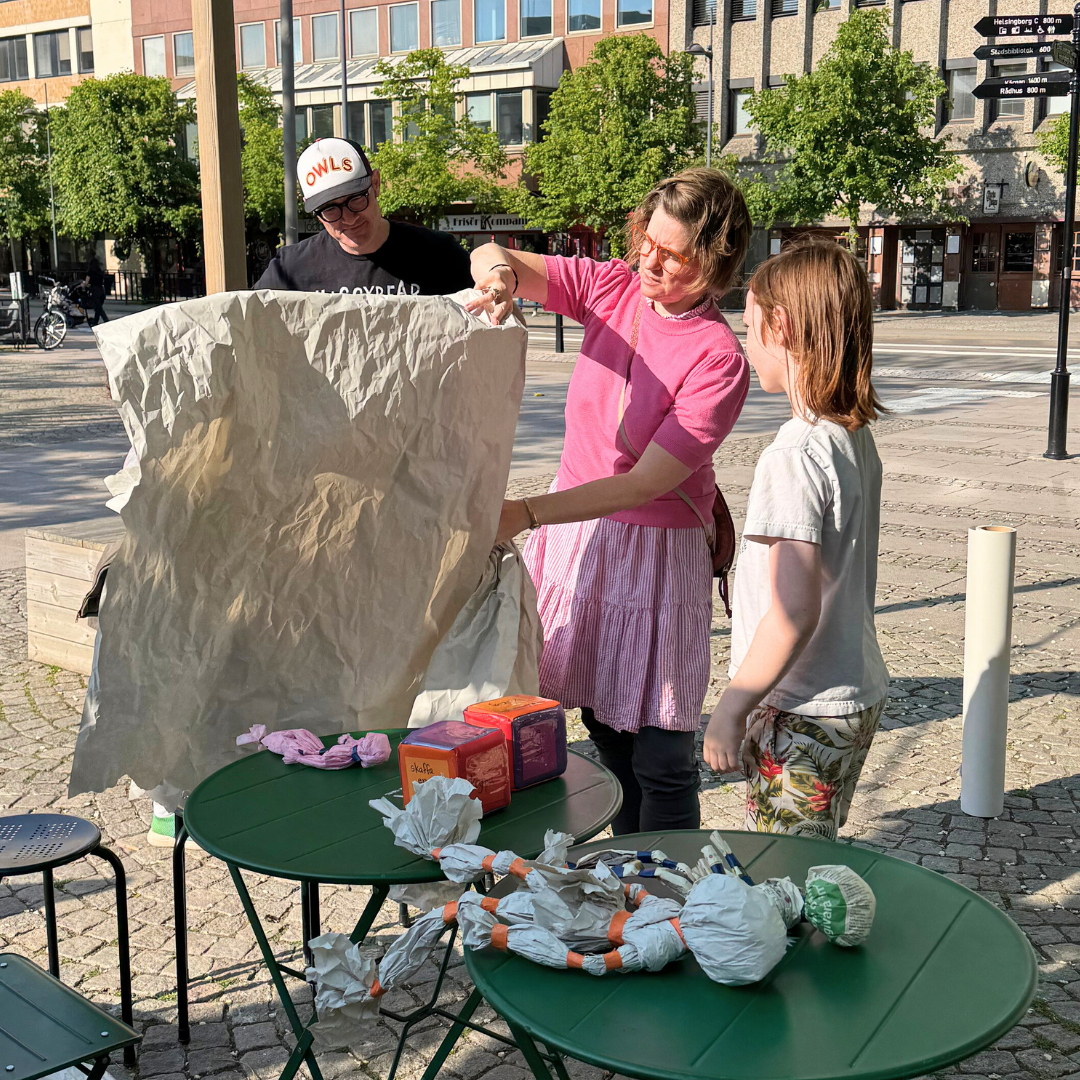
People sometimes ask how puppetry, public art, facilitation, education, and organizational collaborations came to belong to the same body of work.
The honest answer is that I wasn't trying to connect them.
I can now see a pattern that wasn't obvious while I was living it. Rather than asking a practice to answer questions it could no longer hold, I changed the practice.
I realized that movement wasn't separate from the work. It was the work.
The questions have remained consistent.
How do worlds become real through ordinary participation?
What becomes possible before another person's experience becomes something we already know?
How do everyday interactions become so familiar that they stop feeling like participation altogether?
This inquiry has been shaped by many fields, including sociology, community arts, theatre, puppetry, expressive arts, and somatic practice.
One of the most significant shifts in my thinking came through training in Social Therapy with Lois Holzman and other practitioners. Until then, I had largely understood change as emerging through the expansion of individual expressive capacity. The developmental philosophy of Fred Newman and Lois Holzman offered a fundamentally different understanding: development is something people create together through shared activity. That understanding informs my inquiry into participation, even as my artistic practice evolves in its own direction.
Gradually, I stopped looking for better methods and became increasingly interested in the conditions through which participation itself is created.
One of the first places I noticed those conditions was during my training in puppet therapy.
I became fascinated by how quickly people participated in what they believed an unfinished figure to be.
Nothing about the puppet had changed. Only the conditions of the encounter.
Years later, while facilitating with people living under the conditions of war, the practices I trusted reached their limits.
I could have defended the practices. Instead, I changed them.
That movement has repeated throughout my work ever since.
Whenever a practice reaches the edge of what it can hold, I don't experience it as something to either preserve or discard.
I experience it as an invitation to listen more carefully to what the inquiry is asking next.
An artistic practice of composing conditions
Today I think of my work as an artistic practice of composing conditions.
Rather than explaining participation, I compose situations where different ways of participating can be experienced and compared.
Some of those situations take the form of public artworks. Some become educational laboratories. Some become relational practices, and some become long-term collaborations inside organizations.
The medium follows the inquiry.
Participants encounter ordinary situations under slightly different conditions, comparing what different ways of participating make possible, as well as what they make less available.
Over time, participation itself becomes something they can perceive rather than simply enact.
Where the inquiry lives
Today, the inquiry continues through a series of original practices, including School of the Small and Imperfect, Deep Puppetry™, Witnessing Without Colonizing, participatory artworks, and long-term collaborations with organizations, municipalities, cultural institutions, and communities.
I've stopped looking for the practice that will finally be enough. I've learned to trust the moment when a practice can no longer carry the questions that brought it into being. That's usually where the next one begins.
The inquiry continues. The practices continue to evolve with it.
Training & Lineage
Every practice on this site has emerged through more than twenty years of artistic practice, facilitation, performance, somatic study, community work, and participatory experimentation. Rather than a list of credentials, I think of lineage as an ongoing conversation with the people, disciplines, and communities that continue to shape the work.